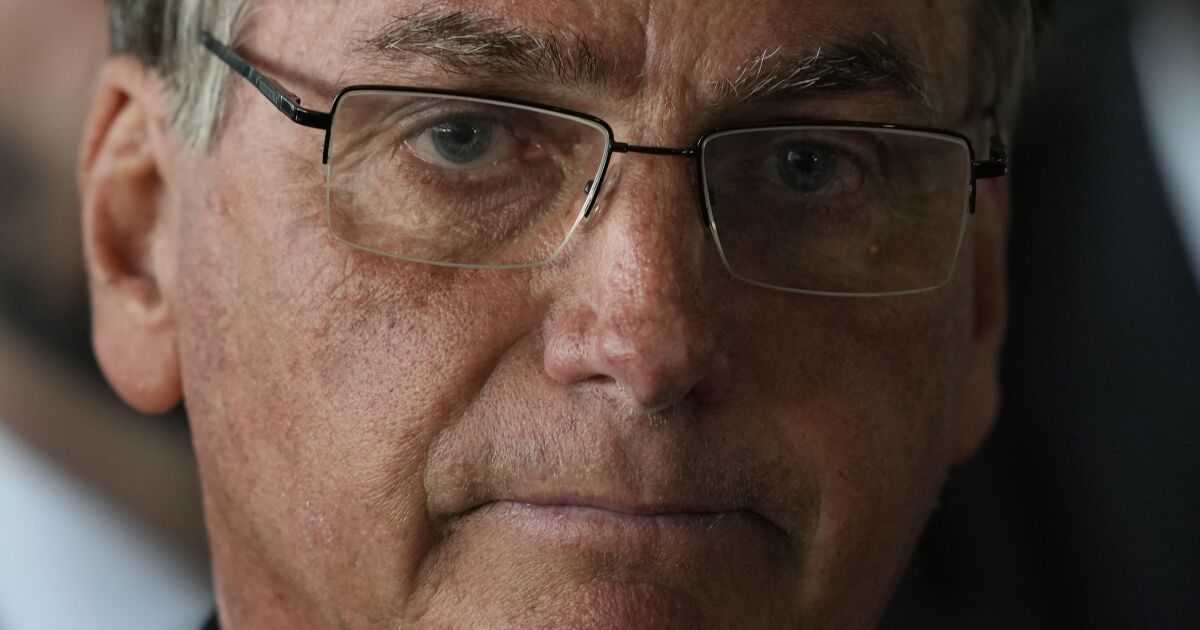
The U.S. government is struggling to contend with the Florida stay of former Brazilian President Jair Bolsonaro, who many blame for violent riots this week in Brazil’s capital.
And the conundrum for the Biden administration is playing out as America continues to reckon with the threat to democracy posed by the Jan. 6, 2021, attack on the U.S. Capitol, to which the Brazil insurrection is being compared.
Top U.S. officials, from President Biden down, quickly condemned the violence and voiced support for Brazil President Luiz Inácio Lula da Silva, who entered office earlier this month. Biden telephoned him and again extended an invitation to the White House, expressing “the unwavering support of the United States for Brazil’s democracy and for the free will of the Brazilian people.” He called the violence “outrageous.”
But the elephant in the room — or in Florida, in this case — was not mentioned in the conversation between the two leaders.
A little more than a week before his supporters stormed Brazil’s three most important government institutions, Bolsonaro slipped away to Orlando, where he is reported to be staying at a friend’s mansion near Disney World.
Photos posted on social media show him strolling through a supermarket and eating at a KFC restaurant. On Monday, he said he was checking himself into a hospital for treatment of an old wound he suffered during an assassination attempt.
Bolsonaro refused to recognize the victory in presidential elections of his archrival Lula, did not attend the Jan. 1 inauguration and has stoked false conspiracy theories about fraudulent voting. Few were surprised at the explosion of violence on Sunday.
“It was violent aggression, planned well ahead, and clearly inspired by the events that happened at the Capitol on Jan. 6,” said Bruna Santos, a senior advisor at the Wilson Center’s Brazil Institute.
Bolsonaro’s exact role in the riots, which saw thousands of people smashing windows, attacking police and setting fires, is not yet clear.
The events deliberately mirrored the Jan. 6, 2021, attacks on the Capitol by supporters of then-President Trump who subscribed to his false claims of a stolen election.
Bolsonaro and Trump have been political soul mates, with the former U.S. president calling the far-right Brazilian the “Trump of the tropics” among other similar labels intended as praise. Bolsonaro and his sons, several of whom are also politicians, frequently consulted with Trump strategist Stephen K. Bannon on how to win elections. Bannon has used his own media platforms in an attempt to undermine the Brazilian elections in much the same way he did in the U.S. vote, spreading disinformation about voting machines.
With a different president now in the White House, Bolsonaro’s presence in the U.S. is raising different questions and possible scenarios.
Several Democratic members of Congress are demanding the government expel Bolsonaro.
“Bolsonaro should not be in Florida,” said Rep. Joaquin Castro (D-Texas.). “The United States should not be a refuge for this authoritarian, who has inspired domestic terrorism in Brazil. He should be sent back to Brazil.”
In addition to bureaucratic considerations such as the procedures that would have to be followed, the Biden administration also has to weigh the political costs of any action.
In some conservative circles, Lula, a leftist, is likened to the region’s more extreme socialists like the late Hugo Chávez of Venezuela, and support for him is condemned. But Lula has shown himself to be more respectful of democracy than Chávez and has been willing to work with opposition parties.
To be removed, Bolsonaro would have to be extradited or expelled. Extradition, which has ample precedent, could happen only if the Brazilian government opens a legal case against him and requests he be turned over.
Expulsion, by contrast, would be initiated by the U.S. government and can be ordered for a number of “deportable” offenses, from visa violation to other illegal activity. There is also a “foreign policy” provision whereby the secretary of State can determine that a person’s presence could have “potentially serious adverse consequences” for the U.S.
It is widely believed that Bolsonaro entered the U.S. on an “A” visa, a nonimmigrant visa reserved for important people such as heads of state and diplomats. But the visa would have lapsed when he was no longer president, at which point he would have 30 days to obtain a different visa, according to the State Department.
Late Tuesday, Bolsonaro told a Portuguese-language affiliate of CNN that he was planning on returning home as soon as he got out of the hospital. His son, Sen. Flavio Bolsonaro, told Brazil’s Folhapress that, while many people tried to tie his father to the “sad, lamentable and unjustifiable” violence in Brasília, such reports were untrue.
As much as the riots in Washington and Brazil echoed each other, there were key differences. In Brazil, a new president had already been sworn in — at a ceremony attended by 300,000 people and several heads of state — and the buildings attacked by the mobs were largely empty. In Washington, the moment was more precarious: The attackers launched as the presidential vote was being certified and when the Capitol was filled with lawmakers, staffers and civilian security officers whose lives were endangered.
In Washington, the goal was to overthrow an election; in Brasília, it was to entice the military to step in and take over the elected government.
Another distinction between the two attacks has been the aftermath: Unlike in Washington, Brazilian politicians quickly came together to condemn the actions and demand an accounting of the events.
“There has been understanding across the aisles that this is a serious moment that needs to be approached with caution,” Michael McKinley, a former U.S. ambassador to Brazil, said in an interview. “There has been unity of purpose in investigating what happened and holding those responsible for the violence accountable, and in projecting a government moving forward.”
By contrast, in Washington, numerous members of Congress minimized the violence, opposed an investigation and even persisted in voting against certifying the election after the rioters were subdued.
“There has certainly been a more immediate concerted effort in Brazil to respond to the threat to the country’s democracy that this violence represented,” McKinley said, noting that Brazil’s institutions have steadily consolidated in the three decades since military dictatorship was ended.
Still, while Brazil’s institutions held in the face of antidemocratic onslaught, several red flags have been raised. The military did not go to the aid of the Bolsonaro supporters, but some lower level security officers did, reflecting mixed loyalties at certain levels of law enforcement. Lula has moved quickly to remove some of those implicated in complicity with the mobs, or who failed in their duty to protect government property.
“The lax security response in Brasília underscores a significant challenge that Lula faces,” said Dan Restrepo, a Latin America advisor to former President Obama and senior fellow at the Center for American Progress. “The military leadership has been — and appears to firmly remain — on the side of constitutional order and respect for Brazil’s democratic processes and institutions. The rank and file, however, are something of a mixed bag.”
The violence in Brazil galvanized political forces all along the spectrum in defense of democracy, but also exposed the fault lines that Lula will now have to navigate. In the U.S., two years on from the trauma at the Capitol, Biden also grapples with divisions that have only deepened, with none of the galvanizing unity.