As the artificial intelligence industry heats up, Karman Industries is trying to cool it down.
The Signal Hill startup says it has developed a cooling system that uses SpaceX rocket engine technology to rein in the environmental impact of data centers, chilling them with less space, less power and no water.
It recently raised $20 million and expects to start building its first compressors in Long Beach later this year.
“Our high-level thesis is we could build the best compressor out there using the latest and greatest technology,” said David Tearse, chief executive of Karman. “We want to reduce that electrical consumption of cooling so that you have the most efficient way to cool these chips.”
The high-end, expensive chips that power AI can slow down or shut off when they overheat. They can reach more than 200 degrees, but need to be below 150 degrees to work best.
Cooling warehouses packed with tens of thousands of them can require fields full of equipment and huge quantities of water.
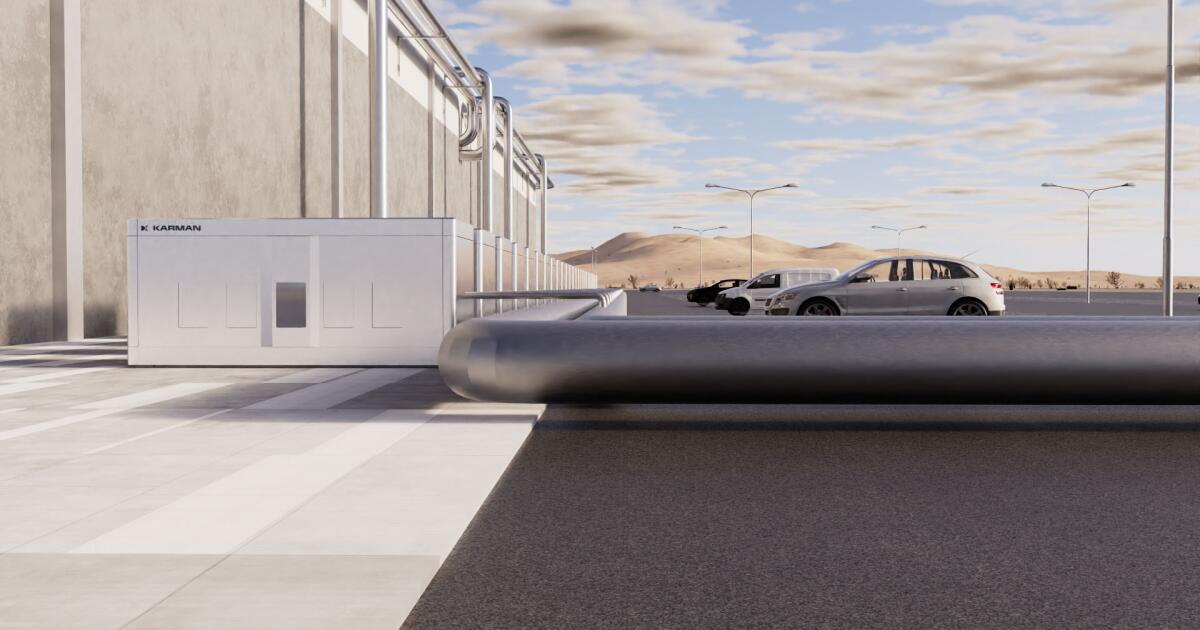
Karman has developed a cooling system similar to the heat pumps in the average home, except its pumps use liquid carbon dioxide as refrigerant, which is circulated using rocket engine technology rather than fans. The company’s efficient pumps can reduce the space required for data center cooling equipment by 80%.
Over the years, data centers have used fans and air conditioning to blow cold air on the chips. Bigger facilities pass cold liquid through tubes near the chips to absorb the heat. This hot liquid is sent outside to a cooling yard, where sprawling networks of pipes use as much water as a city of 50,000 people to remove the heat.
A 50 megawatt data center also uses enough electricity to power a mid-sized city.
As AI has super-sized data centers, adding more and more chips, they have needed increasing amounts of space and power for cooling.
“It’s kind of a losing battle, especially when you keep densifying your chips,” said Tearse.
Cooling systems account for up to 40% of a data center’s power consumption and an average midsized data center consumes more than 35,000 gallons of water per day.
Nearly 100 gigawatts of new data center capacity will be added by 2030 and energy constraints have become the biggest barrier for expansion. U.S. data centers will consume about 8% of all electricity in the country by 2030, according to the International Energy Agency.
Communities across the U.S. have begun protesting data center construction, fearing that the power and water needs could strain infrastructure and boost costs to consumers. The cooling systems are projected to use up to 33 billion gallons of water by 2028 per year.
Big tech companies and venture capital investors are spending billions of dollars to replace old-school technologies with energy-efficient solutions. Microsoft announced a new data center design that uses zero water for cooling. It recently vowed to ensure its data centers don’t increase the electricity costs or deny water to nearby communities.
The data center-cooling market is projected to grow from about $11 billion in 2025 to nearly $25 billion by 2032.
To serve this seemingly insatiable market, Karman has developed a rotating compressor that spins at 30,000 revolutions per minute — nearly 10 times faster than traditional compressors — to move heat.
“Three or four years ago, it was very challenging to do just because the motors didn’t exist. Automotive components are getting up to those speeds,” said Chiranjeev Kalra, co-founder and chief technology officer of Karman.
About a third of Karman’s 23-person team came from SpaceX or Rocket Lab, and they co-opted technologies from aerospace engineering and electric vehicles to design the mechanics for the high-speed motors.
The system uses a special type of carbon dioxide under high pressure to transfer heat from the data center to the outside air. Depending on the conditions, it can do the same amount of cooling using less than half the energy.
Karman’s heat pump can either reject heat to air, or route it into extra cooling, or even power generation.
One of the potentially biggest selling points for the systems is that they don’t require water, which will enable data centers in spots where water is scarce.
In really hot places such as Texas and Arizona, cooling systems struggle, either using excessive water to cool or having to throttle the chips to stop them from overheating.
Karman’s latest funding round brings the total money raised to more than $30 million. Major participants included Riot Venture, Sunflower Capital, Space VC, Wonder Ventures, and former Intel and VMware CEO Pat Gelsinger.
Karman said it will begin customer deliveries in the summer of 2026 from its Los Angeles manufacturing facility that is designed to make 100 units per year. The plan is to eventually quadruple capacity.
If successful, Karman could dent the market share of Trane Technologies and Schneider Electric, the leaders in heat rejection systems.