


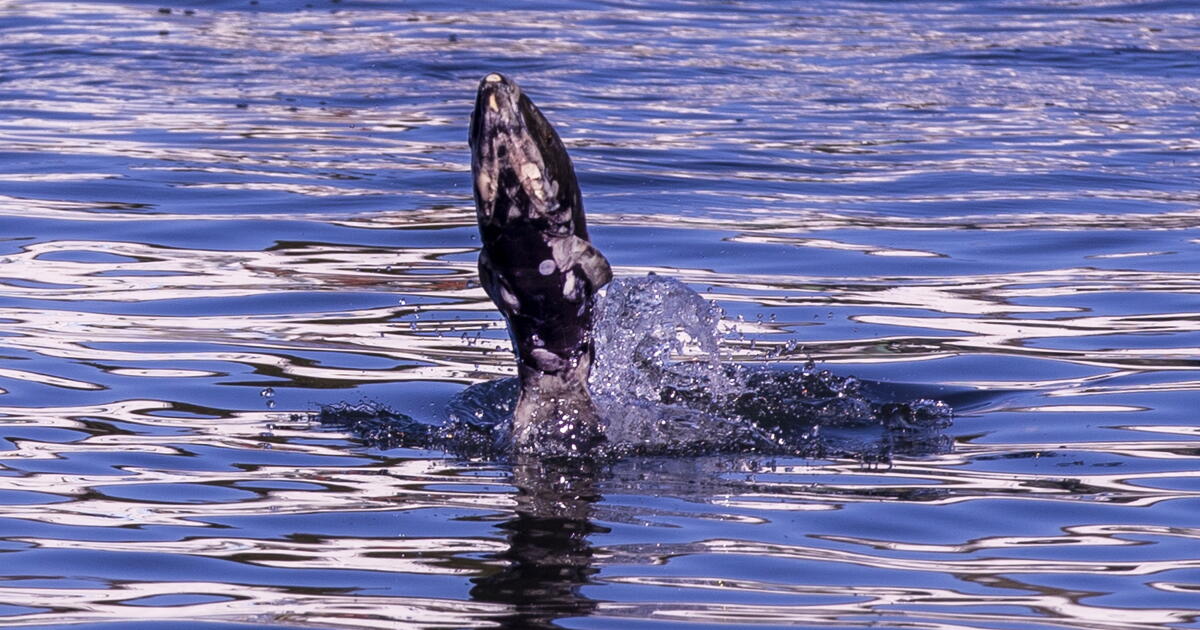
Chinook salmon have been laying eggs in gravelly nests in the Sacramento River for millennia. But California’s biggest river is now so warm that biologists expect a significant number of the eggs won’t hatch.
Environmental advocates blame the Trump administration. They say the federal government took too much water out of Shasta Lake for farms in the Central Valley, leaving the reservoir too warm for many salmon eggs to survive in a vital spawning area downstream from Shasta Dam.
“The fish are not being protected,” said Jon Rosenfield, science director of the nonprofit group San Francisco Baykeeper. “We know that those eggs are getting cooked.”
It’s happened in previous years. Chinook salmon need cold water for their eggs to survive. When it gets warmer than 53.5 degrees, it becomes lethal.
State biologists who monitor salmon nests in the Sacramento River estimated on Sept. 4 that about 20% of the eggs may not survive. The river has gotten warmer since then.
Rosenfield said the U.S. Bureau of Reclamation took excessive water this spring and summer despite warnings.
The federal dam agency defended its work.
“The Bureau of Reclamation is managing Shasta operations under a temperature management plan developed in coordination with state and federal fishery agencies,” Reclamation spokesperson Peter Soeth said in an email.
It is complying with the Endangered Species Act, he said.
State officials have also criticized the Trump administration’s push to pump more water to Central Valley farmlands.
Shasta Dam stands 602 feet tall, forming California’s largest reservoir. Since its completion in 1945, the dam has blocked Chinook salmon from returning upstream to the cold spring-fed streams near Mt. Shasta where they once spawned.
(Allen J. Schaben / Los Angeles Times)
For decades, dams have blocked salmon from many of their historical spawning areas. In recent years, as global warming has intensified droughts and heated rivers, salmon numbers have declined dramatically.
Each year, the Bureau of Reclamation is required to have a plan detailing how it will keep water downstream from Shasta Dam cold enough to protect salmon. In June, regulators at the State Water Resources Control Board objected to the Trump administration plan, saying they were concerned about the temperature.
“California is continuing to see climate change-driven losses in snowpack that result in far less cold water available in the Shasta reservoir for releases to support salmon,” said Jackie Carpenter, a spokesperson for the state water board.
She noted that the board “raised concerns with the Bureau of Reclamation this spring regarding its approach.” She said in an email that the state will continue monitoring and consider options for keeping temperatures in check.
Rosenfield said the state could have required the Trump administration to keep more water in Shasta Lake to protect fish, but failed to act.
“There was absolutely ample water available to keep it colder,” he said, but the Trump administration chose to take large quantities of water out of the reservoir this summer.
San Francisco Baykeeper is one of two environmental groups suing the Trump administration in federal court over the issue of river temperature, arguing it’s violating the federal Endangered Species Act.

A biologist near the bones of a Chinook salmon on the banks of the Sacramento River in Redding.
(Allen J. Schaben / Los Angeles Times)
Others who closely watch the issue say it’s too soon to tell how many salmon eggs will die, and how the toll this year will compare to previous years.
“It’s of concern, but you need more data before you start accusing [the federal government] of operating this way,” said Greg Gartrell, a former manager of the Contra Costa Water District. “It’s a complicated situation, and we don’t have enough data yet.”
Scientists track distinct “runs” of salmon in the Sacramento River, each named for when the fish return from the Pacific and swim upriver to their ancestral streams to spawn. The endangered winter-run Chinook finished spawning in August, while the spring-run, listed as threatened, start spawning in September.
The most numerous are the fall-run Chinook, which fishers catch along the coast when their numbers are high enough. For the last three years, however, there were so few fall-run Chinook that regulators banned commercial fishing.
Environmental and fishing groups accused federal and state agencies of causing the shutdown by mismanaging water during the last drought from 2020 to 2022. At one point, the Sacramento River got so warm that most of the eggs and young fish died.
“The Bureau of Reclamation practically sterilized the Sacramento River,” said Barry Nelson, an advisor with the Golden State Salmon Assn. “They killed virtually all the juvenile salmon.”
Wet winters in 2023, 2024 and 2025 helped increase salmon numbers. This year, commercial fishing boats again spread out along the coast as regulators allowed fishing under strict limits.
Now, with the river again too warm, Nelson said he’s concerned about another potential shutdown.
“It’s too early to know how bad the mortality is going to be this year, but we’re off to a terrible start,” he said.
Nelson said as the Trump administration weakens protections for endangered fish, state officials should take a more aggressive stance.
“We need the state of California to defend salmon,” he said. “Right now, they’re not.”









