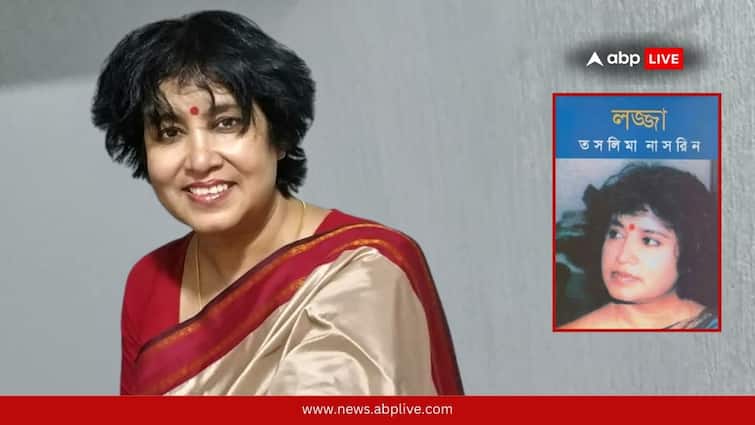
Kolkata: A fresh controversy has erupted in West Bengal over exiled writer Taslima Nasrin’s novel ‘Lajja’. A play based on the book, scheduled to be staged at theatre festivals in Gobardanga and Pandua, has become the centre of a political and cultural storm, with the author accusing the Mamata Banerjee-led West Bengal government of suppressing art, and the ruling Trinamool Congress party saying she is trying to “fish in troubled waters”.
It all started after Taslima Nasrin wrote in a Facebook post that the state government cancelled the performance, promotions for which had been going on for the last two months.
Mamata Govt Has Banned ‘Lajja’: Taslima Nasrin
Taslima Nasrin, in her social media post, claimed that Chief Minister Mamata Banerjee’s government prohibited the staging of ‘Lajja’, citing potential “communal riots”.
According to her, the Pandua police instructed the organisers to cancel ‘Lajja’ while allowing other plays to proceed as scheduled. “The Nabapalli drama troupe from Delhi has staged Lajja three times in the past, with packed audiences each time. Why would the West Bengal government fear riots over a story that originates in Bangladesh?” Nasrin posted on December 23.
She wrote that the police said the “Muslim community would create unrest” if the play was staged, asking why the Bengal government was banning art and literature instead of taking action against the elements they suspect would resort to violence — a question that she said no one else seems to be asking.
According to her, the play scripted and directed by Bishwajit Singh was scheduled to be performed at theatre festivals in Gobardanga in North 24 Parganas, and Pandua in Hooghly.
Organisers Cite Actor’s Illness
The Pandua theatre festival began on December 25, and ‘Lajja’ was originally slated for December 29.
Biswajit De, the secretary of the Pandua club organising the theatre festival, denied the author’s allegations, according to an ABP Ananda report. He explained that the play had to be postponed because one of the actors was unwell. “The decision to replace the play with another production was purely logistical. There was no pressure from the administration,” De was quoted as saying.
Speaking to ABP Ananda, Taslima Nasrin said instructions have been apparently given to the organisers of Gobardanga festival also to cancel the play.
Ashish Das from the Gobardanga theatre festival, however, denied this. He said the play has not been cancelled, clarifying that ‘Lajja’ was not included in the first phase of the festival (December 19–25). “The play is scheduled for the second phase, on January 1.”
The police also claimed that there has been no interference from their side.
‘Trying To Fish In Troubled Political Waters’
The controversy quickly took on a political dimension, with the Bharatiya Janata Party (BJP) accusing the state government of censorship. “Some kind of pressure must have been there. There is always retaliation if things are not in the government’s favour. And that’s why pressure tactics is used to suppress dissent. The state fears the truth will reach the public,” said Tushar Majumdar, BJP’s Hooghly district president.
The ruling Trinamool Congress, however, dismissed the allegations as baseless. Asit Chattopadhyay, TMC’s Hooghly district secretary, said Taslima Nasrin should contact the organisers directly instead of making “unsubstantiated claims” on social media. “She is trying to fish in troubled political waters,” he said.
Lajja, A Controversial History
This is not the first time Taslima Nasrin has faced opposition in West Bengal. Her works, including ‘Lajja’, have often drawn criticism and sparked debates over freedom of expression and communal sensitivities. Nasrin wrote in her post how a television series based on her work, ‘Duhshahobas’, was also cancelled by the state government for similar reasons.
In the past also, she wrote, West Bengal had banned her from the state citing communal tension due to her writings.
The allegations of a ban on ‘Lajja’ come amid ongoing communal tensions in neighbouring Bangladesh, which have had some cross-border cultural and political implications in West Bengal.
The plot of Taslima Nasrin’s ‘Lajja’ revolves around the anti-Hindu riots that broke out in Bangladesh following the demolition of the Babri Masjid in India’s Ayodhya on December 6, 1992. The book highlights the growing tide of communal tensions and the oppression faced by the Hindu minority in Bangladesh, including rape, loot and killings, besides the diminishing presence of secular values.
The book was banned in Bangladesh, forcing Nasrin to flee Bangladesh as she started to receive death threats from Islamic groups. According to reports, people were demanding her execution, with the Council of Islamic Soldiers, a radical fundamentalist group, offering a bounty on her head in October 1993.
Taslima Nasrin fled Bangladesh in 1994 and spent the following decade in exile, residing in Sweden, Germany, France, and the United States. It took her some time to get a visa to come to India. In 2004, she relocated to Kolkata, where she lived until 2007, when she had to eventually leave West Bengal.
According to a 2007 report in Times of India, Kolkata had seen witnessing violent agitations demanding her expulsion, with Jamiat-e-Ulema-e-Hind leader Siddiqulla Choudhury and his supporters burning her effigy. CPM state secretary Biman Bose was quoted as saying that Nasrin should leave Kolkata because “some people don’t want her to stay here”.
Subsequently, she went to New Delhi where she had lived under house arrest for three months before leaving the country in 2008. Nasrin later returned to India but her efforts to get back her Bangladeshi passport, which was revoked, never succeeded.